
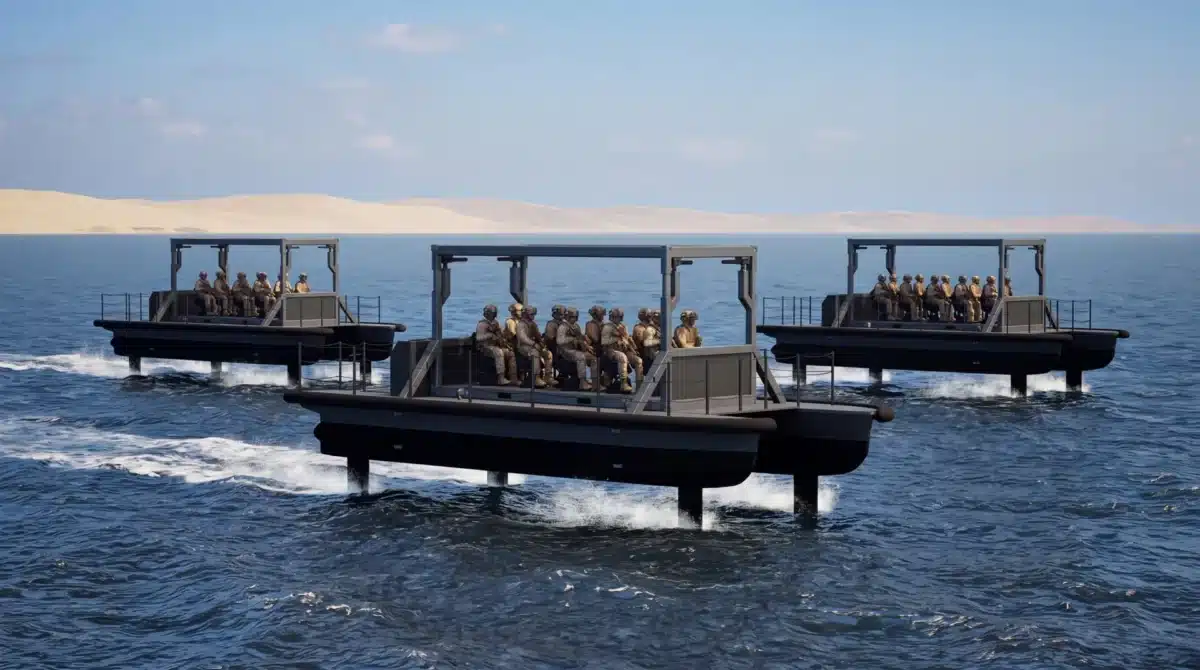
Unveiled in its Defense & Offshore configuration at Euronaval 2026, BOAXT brings a modular approach to maritime engineering. Looking towards 2027, the concept could become a family of adaptable systems for defense, offshore and environmental operations.
What if the next generation of maritime infrastructure began not in a shipyard, but with the dimensions of a shipping container? That is the idea behind BOAXT, developed by LE QUÉRÉ SAS. It challenges the assumption that a vessel’s structure and purpose are fixed from the outset, adapting a common architecture to different missions through modular components.
Its Defense & Offshore configuration, unveiled as a world premiere at Euronaval 2026 in Paris, opened highly promising avenues, notably with Scandinavian countries, Turkey and India. Yet the opportunity extends beyond naval defense.
Rethinking transport and maritime operations
BOAXT folds within the envelope of a 20-foot High Cube ISO container and deploys into a floating platform or catamaran – about 11.2 meters long and 4.7 meters wide in its third generation, still subject to validation. Two first-generation units have been built, one launched in Dubai. The aim: simpler transport and storage, and deployment where marine infrastructure is limited. Interconnected modules can enlarge the usable surface, from mobile workstations to temporary floating infrastructure.
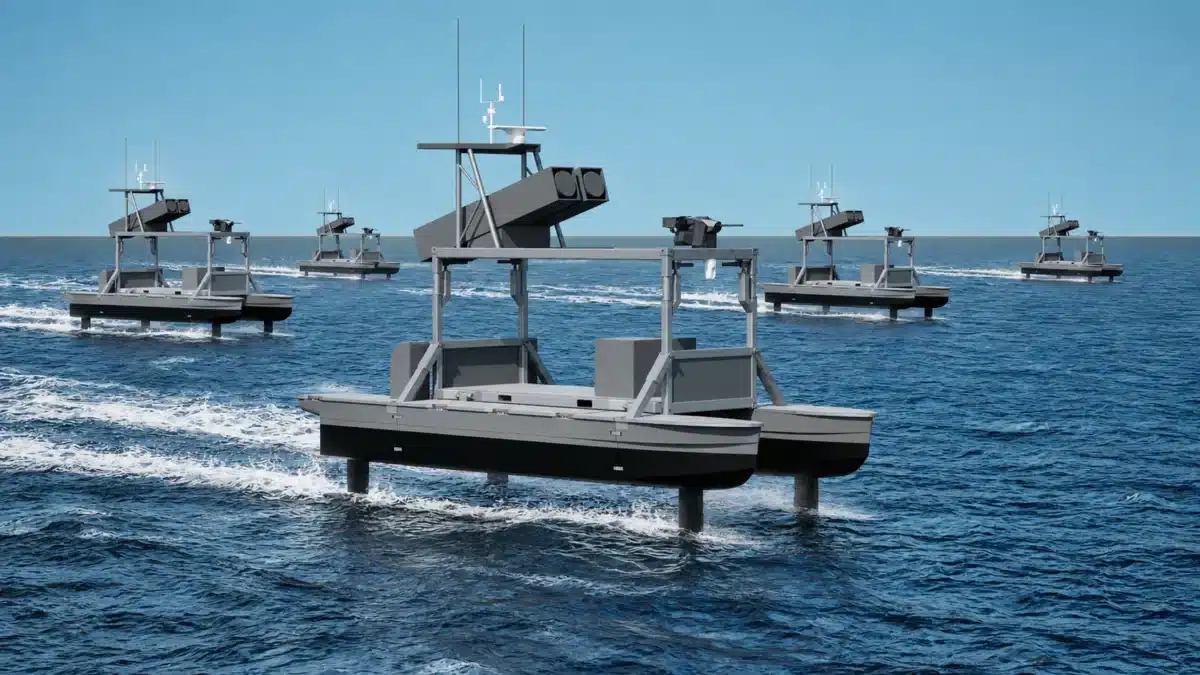
From the offshore platform to the naval drone
The Defense & Offshore version is a reconfigurable system carrying sensors, communications and mission payloads for surveillance, infrastructure protection, offshore inspection and environmental monitoring. With ÆGIR, the project develops autonomous navigation, data processing and multi-unit coordination under human supervision of critical decisions. A mothership with a highly innovative LARS deploys and recovers several units at sea as a coordinated fleet, while H2X-Ecosystems contributes hydrogen fuel-cell expertise.
Towards a broader family of applications
Configurations could serve offshore technicians, port operators, environmental sensing and pollution response, or maritime security. Reusing common components could reduce engineering duplication, simplify maintenance and foster an ecosystem of specialized module developers, provided enough commonality survives full engineering and certification.
Why 2027 could become a turning point
2027 marks a potential shift from demonstrations to industrialization, building on over five years of investment and on four patents filed in France and internationally, three for BOAXT, one for the LARS, all invented by company president Eric Le Quéré.
In Q1 2027, he is to establish BOAXT Systems, a French and sovereign company whose capital will be opened to partners, anchoring in Brittany a defense- and export-oriented industrial project. The first fast Defense & Offshore unit is due to launch in Q3 2027, followed by testing and certification in Q4, and series production from early 2028, rising to one unit per week per line – some fifty a year, a deliberately conservative target. Operating in nodal mode with its AI layer, BOAXT is likely to be sold as flotillas; with local assembly abroad, output could exceed one hundred units a year by 2030.
Exclusive licences with technology transfer will let partner and allied countries assemble locally on a shared engineering base. Japan’s SARAYA has signed one and will manufacture locally; relatively advanced talks are under way with the UAE, where early development took place. The timeline still depends on investment, qualification and commercial commitments.
A new way of thinking about maritime assets
BOAXT’s proposition is not simply that a container can become a boat, but that maritime assets can be modular, transportable and software-enabled. The challenge is to make them reliable and competitive. If BOAXT succeeds, its legacy may be an industrial philosophy built on adaptability rather than a single fixed mission.